7 Things Every Caregiver Should Do Right Now
Tips from caregivers on the frontlines of elder care.

Fifty-three million Americans are managing someone else’s care, and most are doing it reactively. While the specifics differ, one family managing a recent Alzheimer’s diagnosis, another reacting to a sudden fall. The toll it takes is universal. The caregivers we’ve spoken to on the frontlines say they spend their days "piecing it together."
While every caregiving journey is unique, the challenges follow familiar patterns. To move out of constant reaction, caregivers need a clearer, more structured way to track what’s happening, and what needs to happen next.
1. Stop Confusing Scattered Notes with Real Organization
I have a note in my phone, a notebook in my bag, and a WhatsApp thread with my sister, and even then I still missed my mom’s medication refill last week.
In a scientific experiment, researchers rely on a single, controlled record of observations and results to ensure the integrity of their findings. When caring for a loved one, that same single source is often the difference between a managed situation and a looming crisis. Many caregivers feel organized because they have information recorded, but if that data is spread across notes apps, spiral notebooks, and text threads, it isn't a system, it’s a risk.
Disconnected information creates a “search tax” every time an answer is needed. It’s in these gaps that dangerous oversights happen.
To reduce this risk, caregivers can keep every piece of information into one shared place. When data is unified, they stop managing fragments and start seeing the full picture, allowing them to see what’s missing before a small miss becomes a hospital visit.
2. Answer "Just Tell Me What You Need" with a Clear Checklist
My brother kept saying, ‘let me know what you need,’ and I didn’t know where to start.
In most families, the "mental load" of caregiving falls on one person. This primary caregiver becomes the keeper of all the details, while well-meaning family members stand on the sidelines. "Just tell me what you need" is meant to be helpful, but it often adds to the caregiver’s burden, forcing them to act as a project manager for people who don’t see the full scope of the day-to-day.
Making daily tasks and responsibilities visible to the entire family and care network shifts the dynamic from "waiting for instructions" to "shared ownership." When the work is documented and easy to see, others can step in where they’re needed, without being asked.
3. Track the "Small" Changes to Identify Big Patterns
My aging mother kept saying everything was fine, but I had a feeling something had changed and I couldn’t put my finger on what it was or what day things really started to feel different.
Subtle shifts in behavior, a slight change in appetite, a new moment of confusion, or a minor decline in mobility, are often dismissed as one-time events or an “off day.” Without a consistent log, it’s difficult to tell if something is a fluke or the start of a pattern.
Documenting daily observations creates a clear history that is invaluable during medical appointments. This shifts the conversation from "I think she's more tired lately" to "She has slept two hours more per day over the last three weeks.”
4. You Don’t Know What You Don’t Know
In a meeting with the hospital case manager, they asked me for the exact wording of her advance directive about resuscitation, and I had never even thought that was something they would ask about.
Even experienced caregivers run into moments where a specific question surfaces and there is no clear answer.
Not because it was overlooked, but because it was never obvious that it needed to be gathered in the first place. Over time, caregiving becomes less about managing known responsibilities and more about uncovering what has not yet been surfaced. Documents, preferences, and details often remain dormant until a situation forces them into focus.
Having a structured way to surface the right questions ensures that important information is identified and gathered before it is required, allowing families to operate with greater completeness and fewer blind spots.
5. Decide on the "Crisis Questions" Before the Crisis Hits
We were sitting in the hospital trying to make decisions we had never even talked about.
Most caregiving journeys begin with a sudden event, a stroke, a fall, or a diagnosis, that forces families into high-stakes decision-making in a hospital waiting room. While most families are meticulous about planning the transfer of wealth, only 7% of Americans working with financial professionals have ever discussed the actual mechanics of elder-care planning.
Discussing care decisions in advance creates a clearer path forward. Caregivers should talk through preferences around medication management, home care coordination, and legal proxies now, before a crisis. Having these answers in place provides a roadmap when the situation becomes urgent and emotions are high.
6. Caregiving Becomes a Job, and It Needs to be Managed Like One
I thought I could manage it around work, but I’ve had to take more time off than I can afford.
Caregiving rarely starts as a full-time job; it is a "gradual build" that eventually consumes a person’s life. Without a professional approach to managing time, the hidden costs of caregiving—the mid-day pharmacy runs, the constant mental monitoring, the appointments that conflict with work—will lead to a breaking point.
Realistically mapping out the time required for care is not an admission of defeat; it is a strategic necessity. By understanding where time is going and actively managing it, caregivers can reduce wasted time, make better use of the time they have, and better manage their professional and personal commitments before the workload becomes too much to handle.
7. Learn to Ask Better Questions in Clinical Settings
The hospital was presenting us all these different medication options, but I didn’t know the right questions to ask.
At the hospital, "not knowing what one doesn't know" is a significant risk. Medical professionals often present options that are difficult to evaluate without prior experience, and misunderstandings can lead to missed steps, avoidable complications, or decisions that must be revisited later.
Caregivers should treat the clinical environment as a collaborative space where the right companion can make all the difference. Using tools that help identify missing steps ensures they are not just receiving information, but truly understanding it. Asking the right questions the first time is one of the most effective ways to ensure better outcomes for a loved one.
A New Way to Manage the Journey
The transition from "piecing it together" to proactive, organized care is one of the most important shifts a caregiver can make, not just for a loved one’s safety, but to make caregiving feel less overwhelming and more manageable for everyone involved.
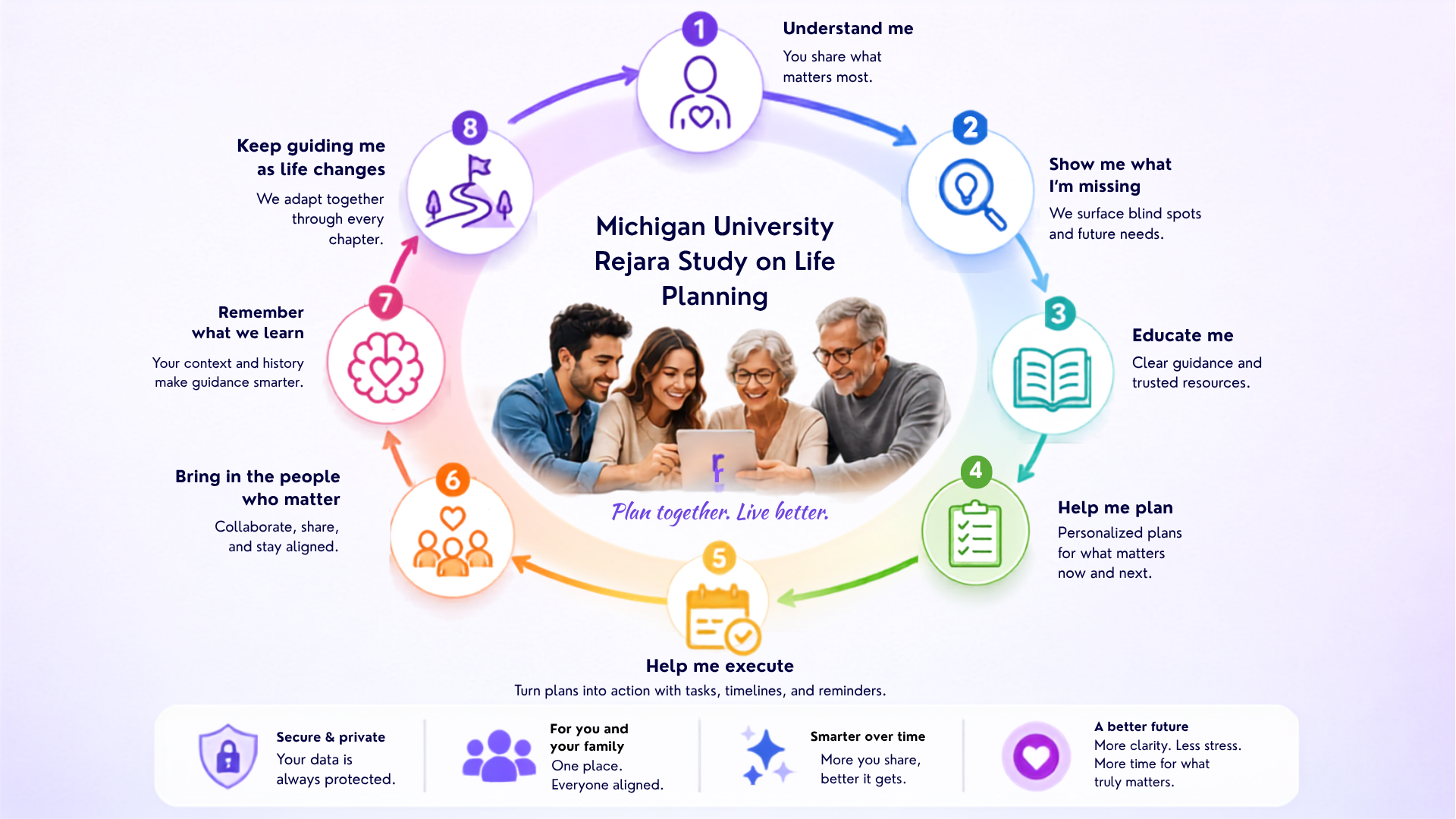
Rejara is an AI caregiving companion that helps families stay organized, reduce stress, and make confident decisions.
By bringing every detail into one secure, connected space, Rejara allows families to share the mental load, track health patterns, and identify missing steps or outdated information before they become urgent risks. It also provides personalized suggestions on what to do next.
Confidence in caregiving doesn't come from doing everything alone; it comes from having the right system in place.
If any part of this feels familiar, this is where you start.