You're Allowed to Laugh: Caregiving is serious. Not every moment has to be.
The moments that remind you who you're caring for
When you spend a lot of time with someone, you develop a shorthand.
Caregiving changes the structure of a relationship, but it does not erase what was already there. For many adult children, it means spending more time with a parent than they have in years, sometimes decades. With that time, something familiar begins to resurface: inside jokes, harmless teasing, and family phrases formed long before anyone was thinking about medications or care plans.
The person they are caring for still says things the way they always have, and it lands in the same place.
The Moment of Hesitation
In the middle of a shared exchange, a caregiver's expression can change slightly, as if the voice in their head is asking: Is this okay to laugh at?
Researchers describe a distinction that caregivers tend to recognize without needing it explained. Some forms of humor create distance, while others reinforce connection. What psychologists refer to as adaptive humor has been linked to caregivers' ability to reframe stressors and garner support from others, contributing to both mental and physical resilience. (PubMed)
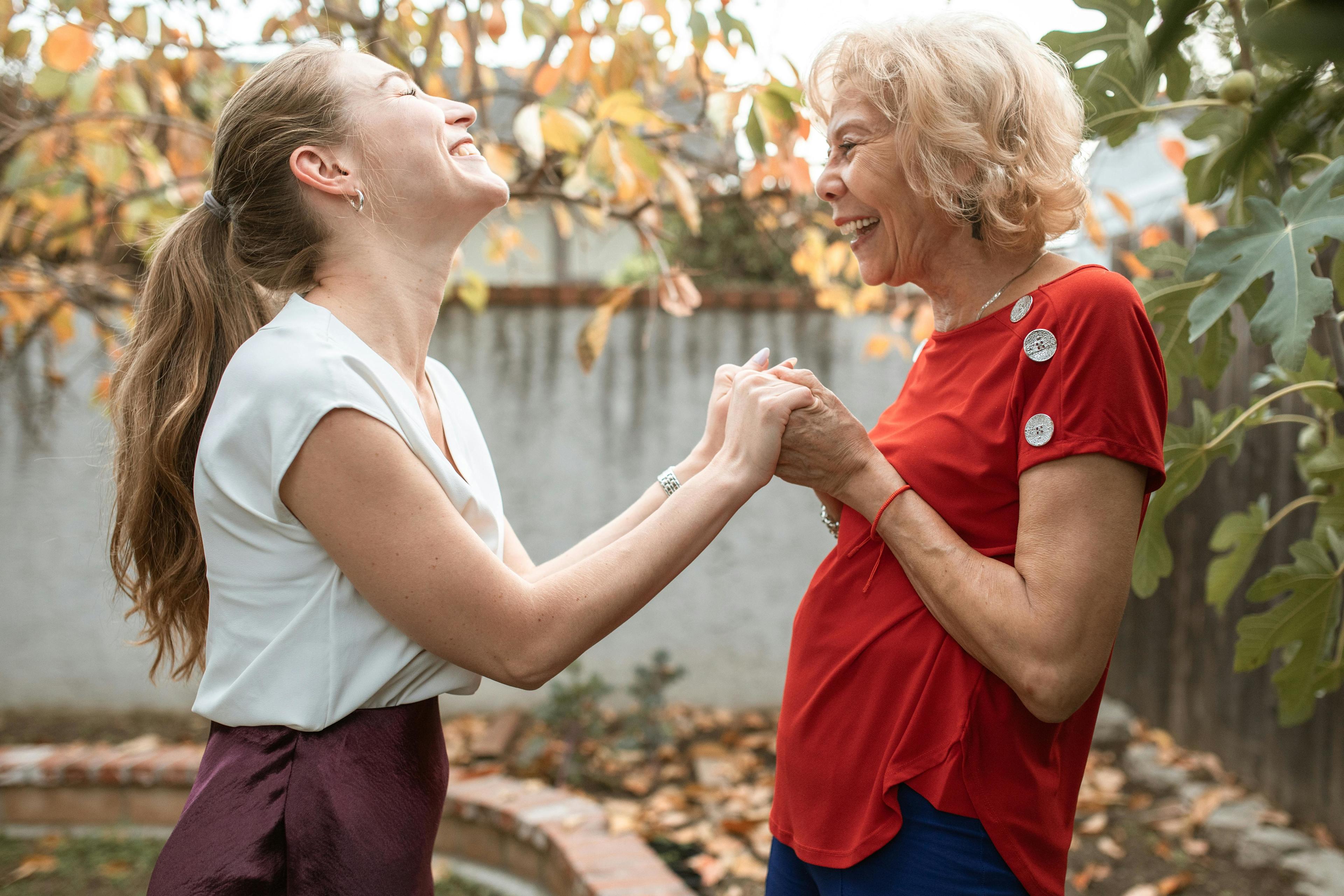
The laughter people describe is not directed at their parent. It moves between them, or sometimes settles quietly within the caregiver after a moment that could have unfolded differently.
What Humor Makes Possible
Humor has been studied as both a coping mechanism and a psychological resource. A 2023 meta-analysis published in PLOS One found that interventions triggering spontaneous laughter reduced cortisol levels by roughly 32 percent compared to non-humorous activities. (PubMed Central) Research also shows that laughter raises levels of beta-endorphins, the feel-good chemicals of the body, and activates the brain's reward system. (VA) Over time, both effects help reduce the kind of tension that builds when someone is managing constant uncertainty.
But caregivers often describe something more immediate.
"You laugh or you cry," one caregiver said. "And I've done plenty of crying."
That sentiment shows up repeatedly across caregiving experiences. The seriousness of what is happening is never lost on the people living through it. But holding everything through that lens alone can become overwhelming. Humor offers another way to move through the same reality without being consumed by it.
In clinical and caregiving settings, humor has been found to protect against psychological strain and enhance coping, including among caregivers managing the behavioral and emotional complexity of dementia. In practical terms, humor changes how a moment is carried, even if nothing about the situation itself has changed.
Where It Shows Up
Caregivers rarely describe these moments as separate from the experience. They are part of the texture of daily life.
They appear in the middle of routines, during meals, on the way to appointments, and in small exchanges that would not stand out to anyone else but that shape how a day unfolds. A comment that arrives unexpectedly, a familiar reaction that surfaces at the right time, or a version of the person they have always known appearing clearly even as other things shift.
"He said something totally out of nowhere and I just lost it," one caregiver recalled. "I hadn't laughed like that in months."
These are the moments that tend to stay. Not the ones that were carefully planned or handled perfectly.
What Caregivers Hold Onto
Caregivers who notice these moments tend to describe them in similar ways. They do not change the trajectory of care or remove the weight of what is happening. What they do is confirm that something essential is still there.
"That's still my mom," one caregiver said. "That part of her, it never went anywhere."
It is easy to move past these moments and return to the next task or decision that needs attention. Caregiving creates a steady forward motion, with little space between responsibilities. But these moments interrupt that rhythm in a way that matters.
The Moments That Build a Record
Many of these moments are not written down. They happen, they pass, and over time they begin to blur together with everything else caregiving requires. But they are often the moments people wish they could return to.
In many families, only one person sees the day-to-day reality up close. Others hear updates, but they do not experience what the day actually felt like. Over time, that distance grows, and the people who care most are left piecing together a picture from the outside.
"I'd try to tell my brother about something funny that happened and it just didn't land," one caregiver said. "You kind of had to be there."
Writing these moments down, even simply, changes that. It captures the personality of the person being cared for, the relationship as it continues to evolve, and the small exchanges that would otherwise disappear into the forward motion of caregiving.
The research on connection keeps pointing to the same thing. The moments that matter most are rarely the ones that were planned. They are the small, repeatable exchanges that accumulate over time, the ones that remind both people who they are to each other.
In a world where daily interactions are increasingly transactional, the responsibility of maintaining that kind of connection is shifting back to individuals and families. Technology cannot replace the familiarity built through shared history. But it can help make those moments visible, shareable, and easier to hold onto.
That is what shaped how we built Rejara. The Journal creates a place to log moments as they happen. And the care network makes it possible to share them with the people who are part of the story, even when they are not there in person. Over time, it becomes something more than a log of tasks. It becomes a record of the relationship itself.
The seriousness of caregiving is always present. No one living through it forgets that. But so are these moments, arriving without warning, carrying something that no care plan could document on its own.
They are worth holding onto.
Sources
Fritz, H. L. (2020). Coping with caregiving: Humor styles and health outcomes among parents of children with disabilities. Research in Developmental Disabilities, 104, 103700. https://pubmed.ncbi.nlm.nih.gov/32497974/
Hickman, L. D., et al. (2018). Humor as a resource for caregivers in dementia care. Referenced in: The Role of Humor in Stress Management and Psychological Well-Being. https://journal.sinergi.or.id
Kramer, C. K., & Leitao, C. B. (2023). Laughter as medicine: A systematic review and meta-analysis of interventional studies evaluating the impact of spontaneous laughter on cortisol levels. PLOS One. https://pmc.ncbi.nlm.nih.gov/articles/PMC10204943/
U.S. Department of Veterans Affairs, Whole Health Library. The Healing Benefits of Humor and Laughter. https://www.va.gov/WHOLEHEALTHLIBRARY/tools/healing-benefits-humor-laughter.asp