10 Questions Younger Adults Are Asking About Life Planning
Younger adults didn't see planning as something they should do entirely on their own. They wanted to learn from their parents' experience, involve them in important decisions, and help their families become better prepared for the future.

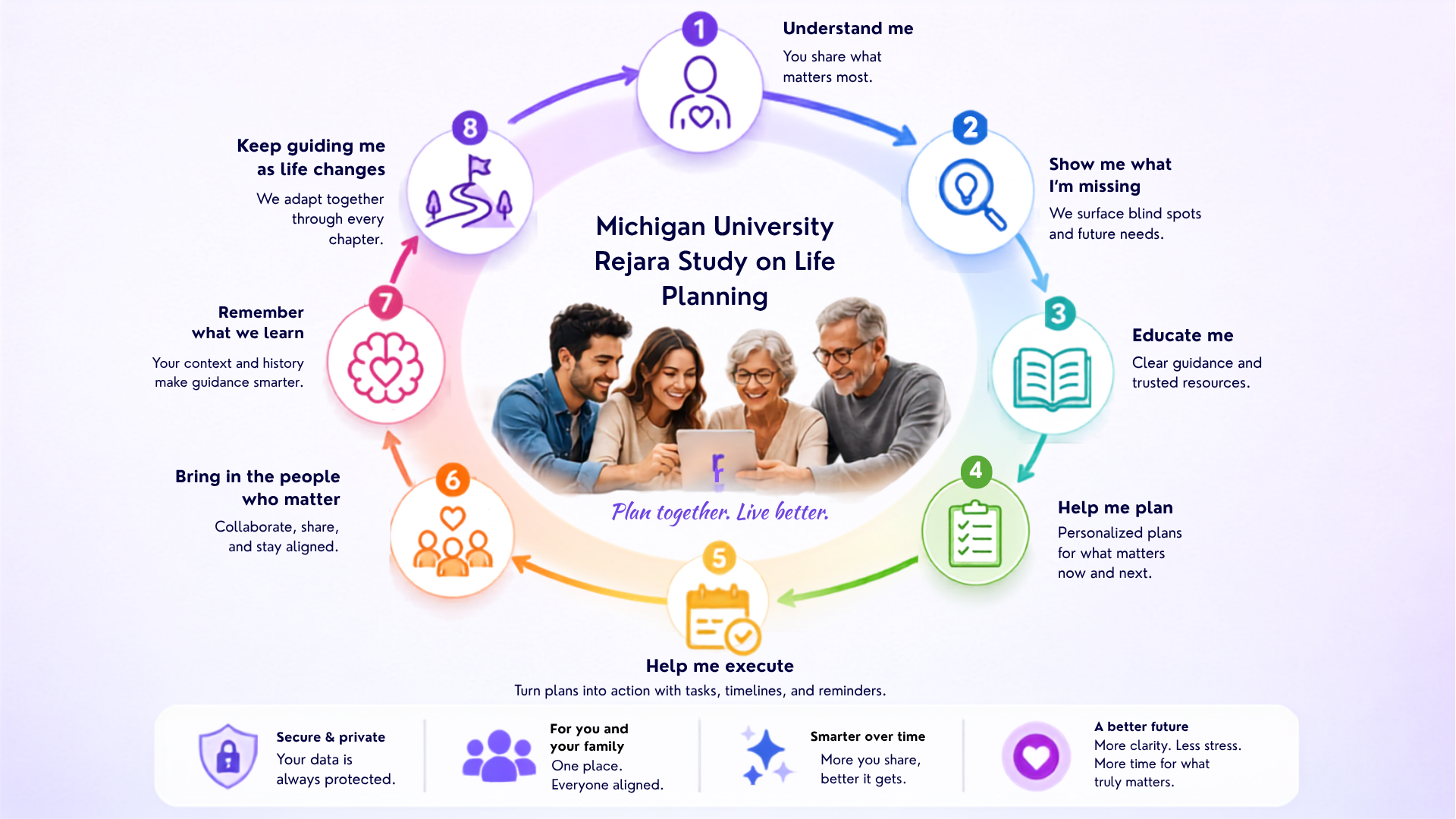
What happens when younger adults are asked to think seriously about their futures? In our University of Michigan research, their questions went far beyond careers and money. They wanted to understand what they might be missing, how AI could help them plan, and how to involve their parents and families along the way. Here are 10 questions they asked about Rejara, and what their questions taught us about how the next generation wants to plan.
Here are the top 10 questions:
1. What should I actually be planning for? You don't need to know everything you should be thinking about before you start. Good planning should help you uncover the questions you haven't thought to ask—not just answer the ones you already have.
2. Why do you need to know so much about me? Because good guidance depends on context. Your goals, finances, family, health, priorities and circumstances can completely change what the right plan looks like. Interestingly, participants told us that being asked thoughtful questions actually increased their trust in the guidance.
3. Why wouldn't I just use ChatGPT? General-purpose AI can answer almost anything. Participants told us they valued having a specialized platform that understands the context of life planning, remembers their circumstances, and turns guidance into structured plans and actions.
4. Can you help me figure out what I'm missing? Yes—and this became one of the most interesting themes in our research. Sometimes the most valuable question isn't the one you came to ask. It's the one you didn't know you needed to ask.
5. Can I learn while I'm planning? Planning shouldn't simply produce an answer. Participants wanted explanations, trusted resources, stories and expertise that helped them understand their options and become more confident making decisions themselves.
6. What happens after I create a plan? A plan only matters if something happens next. Participants wanted to turn plans into tasks, reminders, responsibilities and concrete next steps—and be able to see their progress over time.
7. Can I involve my parents and family? This was one of our strongest findings. Younger adults naturally wanted to involve their parents, learn from their experience, share information and make decisions together. As one participant put it: “Life planning is family planning.”
8. Can my family keep important information and knowledge in one place? Participants saw value in having a shared place for important information, plans, decisions and responsibilities rather than leaving everything scattered across conversations, documents, emails and apps.
9. Will Rejara remember what I've already told it? Participants didn't want to start over every time. They wanted a platform that remembers their circumstances, plans and priorities so its guidance becomes more relevant as it gets to know them.
10. Can a platform stay with me as my life changes? Perhaps the most interesting idea was the shift from a planning tool to a companion. Participants wanted something that could continue learning, adapting and helping as their careers, finances, families and responsibilities change over time.
Perhaps the biggest lesson wasn't about technology at all. It was about family.
Younger adults didn't see planning as something they should do entirely on their own. They wanted to learn from their parents' experience, involve them in important decisions, and help their families become better prepared for the future.
At the same time, they recognized that planning doesn't end when a plan is created. Circumstances change. Families change. Priorities change. Good planning needs to evolve with them.
There is something all generations can learn from that: ask the questions you haven't asked, share what you know, involve the people who matter, and keep planning together as life changes.
That's the kind of planning we're building Rejara to make easier.