What Younger Adults Actually Want From AI
Young adults aren't just looking for another chatbot. They want AI that understands their lives, identifies what's missing, creates personalized plans, helps them take action, brings their families into the process, and remembers what matters over time.
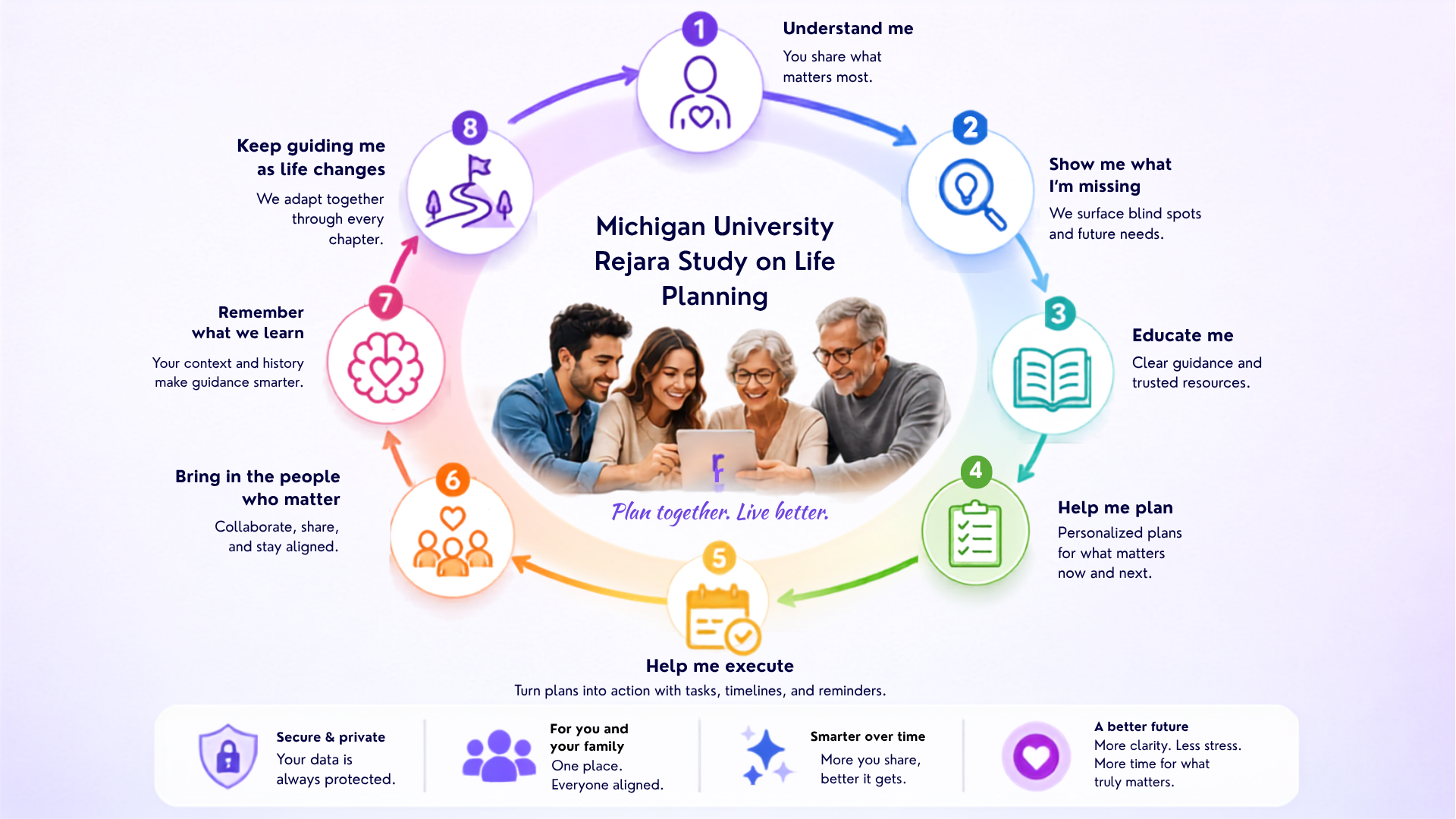
Young adults aren't just looking for another chatbot. Our research with University of Michigan participants points to something more ambitious: AI that understands their lives, identifies what they're missing, creates personalized plans, helps them take action, brings their families into the process, and remembers what matters over time. Here are the 10 new capabilities they told us would make AI genuinely useful for navigating life. Here they are:
Personalized AI onboarding & profile — Rejara should ask thoughtful questions, understand the user's goals, circumstances, family, finances, health and priorities, and build a persistent personal context. Participants specifically valued personalization and questions that helped them think.
AI-powered personalized plans — Turn that context into structured plans across career, financial, legal, housing, health, caregiving and other life needs—not generic AI responses.
Blind-spot & proactive recommendations — Don't wait for users to know what to ask. Identify missing considerations, risks, opportunities and upcoming needs, and proactively say, “Have you thought about this?” Participants valued AI prompting questions they might not think to ask themselves.
Tasks, reminders & calendar — Convert plans into concrete actions with owners, due dates, reminders, recurring tasks and calendar integration. This was one of the most consistently requested execution capabilities.
Family collaboration & sharing — Invite parents, children, siblings or others into specific plans; share information; assign tasks; coordinate responsibilities; and track progress together.
Family knowledge & information hub — One organized place for important information, documents, decisions, preferences, plans and family knowledge instead of information scattered across paper, texts, email and different apps. Participants explicitly imagined Rejara as a centralized family platform.
Education & trusted resources — Provide articles, videos, guides, stories, expert resources and explanations alongside recommendations so users can understand a subject rather than blindly follow AI advice.
Community & expert intelligence — Allow people to learn from others who have faced similar situations and bring in professional expertise when appropriate. Participants wanted communities for sharing experiences and access to professionals when AI alone wasn't enough.
Persistent memory & evolving context — Remember previous conversations, plans, decisions, preferences and family information so users don't repeatedly explain themselves. Participants specifically valued AI that “remembers you.”
Proactive life companion — This pulls everything together. Rejara should continue watching the user's situation, recognize when circumstances change, suggest what needs attention, revisit plans and guide the user through the next stage of life. One participant explicitly saw greater value in Rejara as an AI companion rather than simply a planning tool.
What stood out from these conversations wasn't any single feature. It was the kind of relationship younger adults expect to have with technology.
They don't just want AI to answer a question. They want it to understand their situation, help them discover what they may be missing, turn ideas into plans, help them follow through, and bring the people they trust into the process.
And they don't want to start over every time.
They want something that remembers, learns, and becomes more useful as their lives change.
That's a very different vision of AI, less like a tool we occasionally consult and more like a companion that helps us navigate life over time.
That's the future we're building toward with Rejara.