10 Things Younger Adults Can Teach Us About Planning for the Future
Young people want their parents' knowledge to help them prepare for their future. At the same time, they want their parents to prepare better so that the family can navigate the parents' future together.

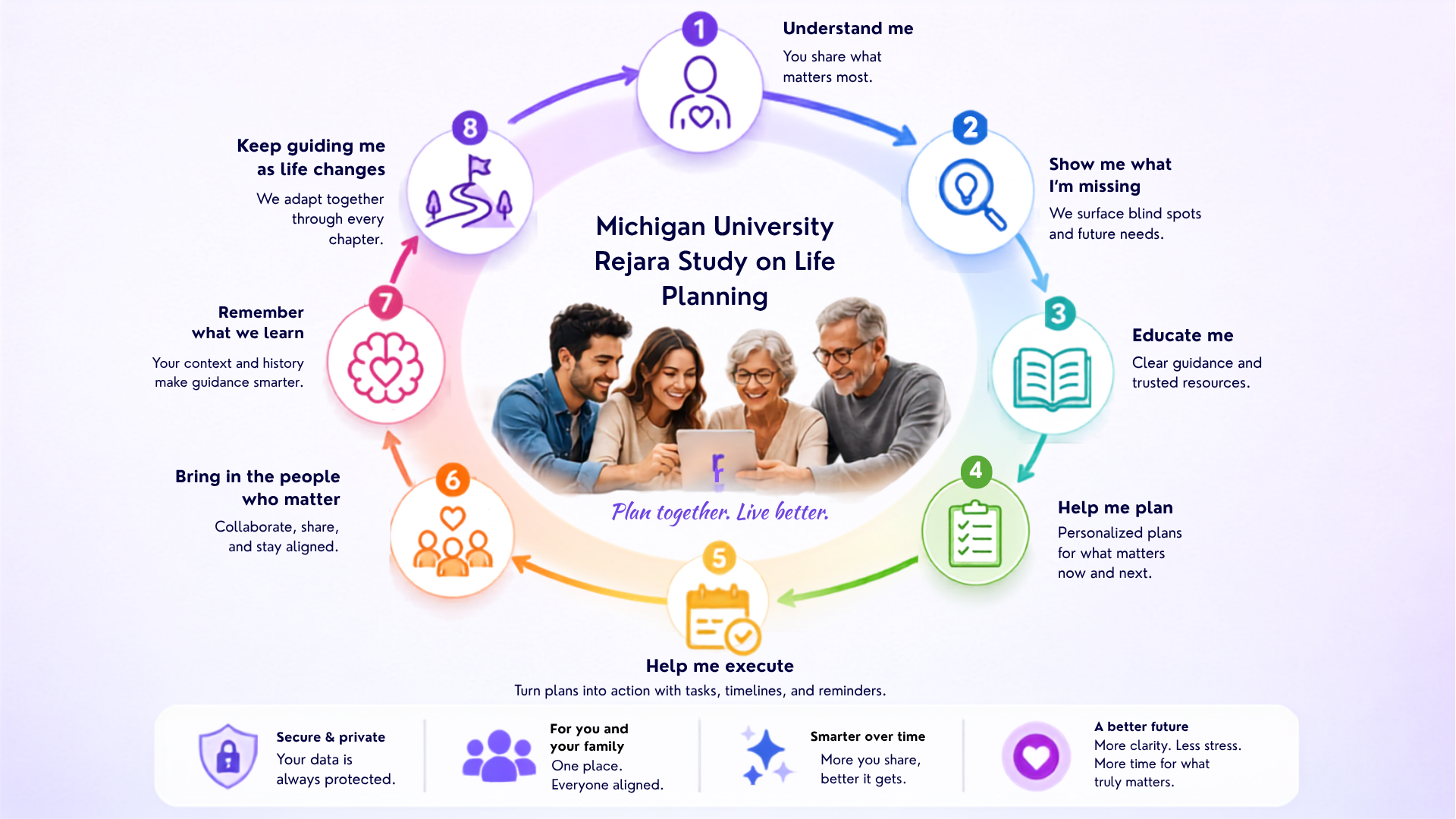
Young people want their parents' knowledge to help them prepare for their future. At the same time, they want their parents to prepare better so that the family can navigate the parents' future together. They may have less life experience, but younger adults are approaching planning with a surprisingly useful mindset: start early, ask what you're missing, involve your family, learn from others, and turn plans into action. Our research with younger adults at the University of Michigan uncovered 10 lessons that may be even more valuable as we get older.
Here they are:
Don't wait for a crisis to start planning. The students tended to think prospectively: career, finances, housing, retirement, parents and future caregiving. One participant explicitly said planning should begin as early as possible. Older adults can apply the same mentality to retirement, housing transitions, health, caregiving, estate planning and legacy: prepare while you still have choices.
It's okay not to know what you should be planning for. Younger participants appreciated being asked questions because the questions themselves exposed things they hadn't considered. The same principle applies later in life. Instead of thinking, “I already know my affairs,” ask, “What am I overlooking?”
Life planning should be holistic. Students didn't compartmentalize their futures neatly into career, finances, health and family. They saw these areas as interconnected; one described life planning as a “blanket” covering personal and professional life and everything between. That's particularly relevant in later life, when health, housing, finances, family and caregiving become increasingly interdependent.
Bring your children into the conversation earlier. This may be the biggest lesson. The students weren't saying, “My parents should leave me alone.” Many wanted the opposite. They wanted to learn from their parents, understand their plans and participate. One participant simply said, “Life planning is family planning.” Parents may underestimate how much their adult children actually want these conversations.
Pass down knowledge, not just assets. Students wanted access to their parents' experience and knowledge. That suggests something profound for older generations: an inheritance isn't only money, property or belongings. It can also include the reasoning behind decisions, family stories, lessons learned, values, relationships and practical knowledge accumulated over decades. This is an inference from the collaboration themes in the research rather than a direct participant statement.
Turn intentions into actions. Younger participants repeatedly gravitated toward tasks, reminders, calendars and progress tracking. “I need to update my will someday” isn't a plan. Neither is “we'll eventually talk about where we'll live.” A plan needs a next action, owner and timeframe.
Use technology to reduce the burden on the family. The students imagined centralized information, shared tasks and family coordination rather than scattered documents and conversations. One participant envisioned Rejara specifically as a central place for family information, planning and task coordination. Older adults can make life substantially easier for their children simply by organizing what matters before anyone needs it.
Keep learning. The students repeatedly asked for education, expert information, stories and trusted resources. Planning shouldn't stop because someone has reached retirement. Medicare, Social Security, investments, housing options, technology, scams, longevity and caregiving continue changing.
A plan shouldn't be static. The younger participants' interest in memory, personalization and an ongoing companion points toward planning as a continuous process rather than a document completed once. The same should apply to retirement plans, estate plans, care preferences and housing decisions: circumstances change, so the plan should change too.
Planning can be an act of care for the people around you. This may be the most important lesson. Preparing isn't solely about protecting yourself. Clear wishes, organized information, documented decisions and shared knowledge can reduce uncertainty for spouses and children when difficult decisions eventually arise.
Younger adults wanted to ask questions, discover what they might be missing, start planning early, involve their families, and adjust their plans as life changes.
Older generations bring something equally valuable: decades of experience, knowledge, stories, and lessons that can help the next generation prepare for its future.
Perhaps the real opportunity is to bring those two perspectives together, sharing what we know, asking what we don't, and preparing for what comes next as a family.